
Sight Word Activities for Special Education: A Teacher's Guide
By Natalie · Special Education Teacher · July 19, 2026
Sight word activities teach students to recognize high-frequency words by sight, instead of sounding them out letter by letter. For students in special education, especially those working on early literacy or those for whom phonics alone isn't enough, sight words unlock functional reading fast, because a handful of words like "the," "is," and "go" show up in almost everything a student reads.
Why sight words matter for special education
A relatively small set of sight words makes up a huge share of everyday text, so mastering them gives a student a real, usable reading skill much faster than building phonics from the ground up. For students with autism or significant learning needs, sight word recognition is also often a strength: it's a visual matching skill more than a decoding skill, which plays to the same strengths that make matching and file folder activities so effective.
Errorless-friendly ways to practice
Errorless practice keeps a student successful from the very first trial, which builds confidence and avoids reinforcing wrong answers. For sight words, that means:
- Field of one, then two, then three. Start by presenting a single word to match or select, then gradually add distractor words as the student gets consistent.
- Identical matching first. Match a word card to an identical word card before asking the student to read the word aloud or select it from a group of similar-looking words.
- Fade the prompt, not the support. Reduce your verbal or physical prompting over trials, but keep the visual structure, the matching format itself, the same.
Adapted books for sight words
Adapted books are one of the best formats for sight word practice, because the student sees the same target word repeated on every page in a predictable sentence structure ("I see the ___," "I like the ___"), which builds automatic recognition through repetition instead of drilling flashcards. A student who struggles to sit for isolated word drills will often read an entire adapted book focused on the same three sight words without realizing it's practice at all. For a deeper library of ready-made adapted books built around this kind of repetitive, predictable text, Adapted Books is a good next stop.
File folder matching for sight words
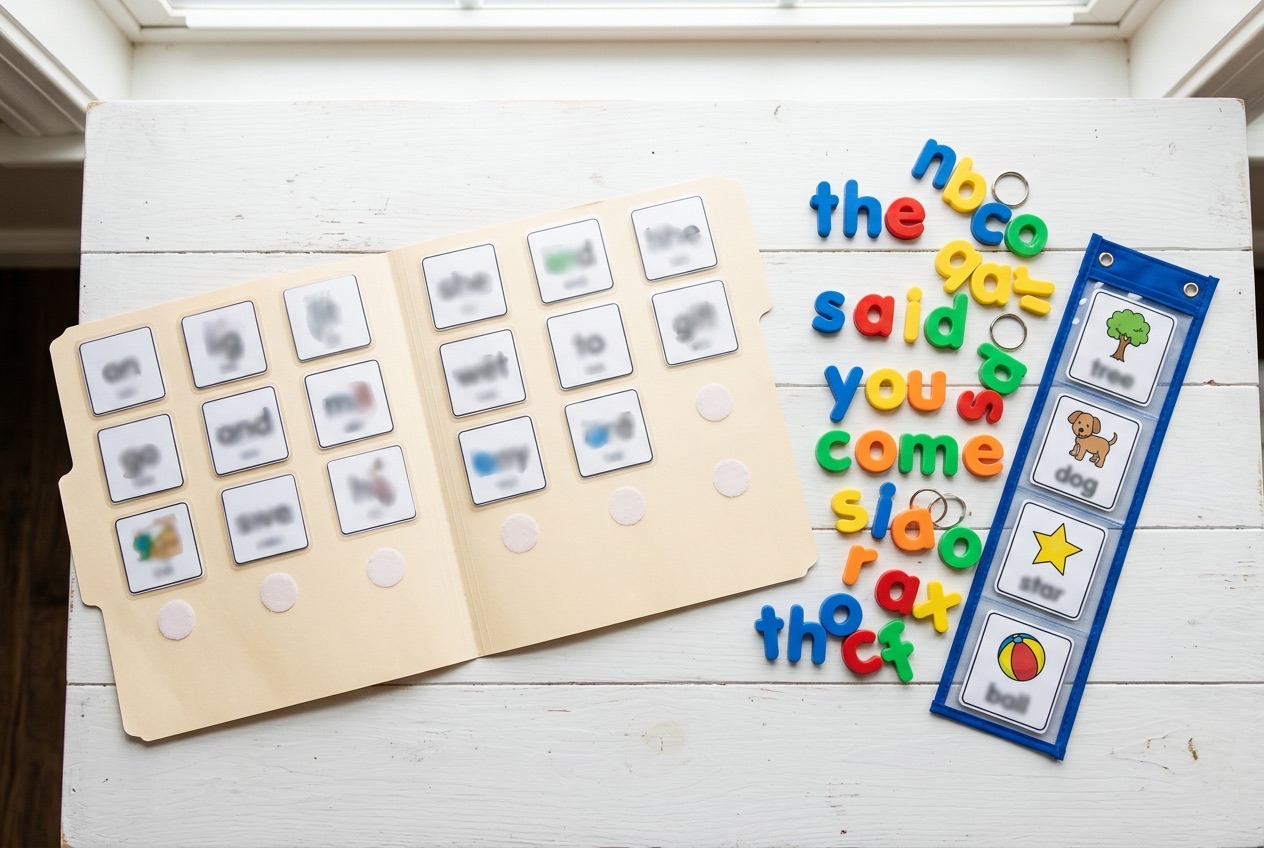
File folder games are just as useful for sight words as they are for shapes and colors: the student matches a word card to its identical match on the folder, which is a low-stakes, self-correcting way to build recognition. Because the format is so predictable, sight word file folder games work well as an independent station once a student already knows the open-match-close routine. See File Folder Games for Autism for the full setup, including how to laminate and store them for reuse.
Multisensory ideas beyond matching
Matching is a great starting point, but mixing in other formats helps a word stick:
- Tracing and writing the word in sand, shaving cream, or on a whiteboard.
- Building the word with magnetic letters or letter tiles from a model.
- Highlighting or stamping the target word every time it appears on a page of text.
- Movement-based practice, like jumping to the correct word taped on the floor.
Where to find ready-made sight word materials
Printable sight word adapted books give you the repetitive, predictable-text format described above, ready to prep and laminate. For matching and file folder practice, browse Just File Folder Games, including plenty of file folder games for preschool and kindergarten sized right for students just starting to build a sight word bank.
Choosing which words to teach first
Rather than working straight through a generic sight word list in order, start with the words that show up most in your specific classroom and in the student's own life: their name, the names of classmates, and functional words like "stop," "go," "help," and "bathroom." A word a student encounters ten times a day gets mastered far faster than a word that only appears on a worksheet, and the early wins build the motivation to keep going through a longer list later.
Progress monitoring that actually fits into your day
Sight word instruction only works if you know which words have actually stuck. Keep a simple running list per student and probe two or three words at the start or end of a session, ideally away from the exact materials used to teach them, so you're checking real recognition and not just memorized card position. When a word is solid across a few different formats, retire it from active teaching and move it into a maintenance rotation you revisit every week or two, so it doesn't quietly fade once you stop drilling it directly.
Common pitfalls to watch for
A few habits slow sight word progress without anyone noticing:
- Teaching too many words at once. Three to five active target words is plenty for most students. A longer active list usually means none of them get truly mastered.
- Only testing in one format. A student who can match a word card may not recognize the same word in a sentence. Rotate formats so you're building real recognition, not just matching to a fixed card.
- Dropping review too soon. A word that's correct three times in a row isn't necessarily mastered. Keep spot-checking mastered words for a few weeks before retiring them completely.
Where to start
Pick three to five high-frequency words that show up constantly in your classroom, the student's name, "go," "stop," "more," and build your first adapted book or file folder game around just those, before expanding the list.
Looking for more? Browse all Guides & Resources, or contact us with questions.