
Matching and Sorting Activities for Autism and Early Learners
By Natalie · Special Education Teacher · July 19, 2026
Matching and sorting activities teach a student to recognize that two things are the same, or that a group of things belongs together, which is one of the very first cognitive skills we teach in early childhood and autism classrooms. Nearly every academic skill that comes later, letters, numbers, categories, reading comprehension, builds on the ability to compare items and decide where they go.
Why matching and sorting come first
Matching and sorting ask a student to look at two or more things and make a judgment about how they relate, without needing language to do it. That makes these activities some of the most accessible early learning tasks for students who are non-verbal or just beginning to build receptive language, and it's why matching shows up so heavily in autism classrooms, from file folder games to task boxes to the very first ABA programs a young learner runs.
The skill progression
Matching and sorting aren't one skill, they're a ladder, and knowing where a student sits on it helps you pick the right next activity.
- Identical matching. Matching two items that are exactly the same (same picture, same object, same color chip). This is almost always the starting point.
- Non-identical matching. Matching items that represent the same thing but look different (a photo of a real apple to a cartoon apple, a lowercase letter to its uppercase pair). This asks the student to generalize past an exact visual match.
- Sorting by one feature. Grouping items by a single obvious trait, like color or shape, with just two categories to start.
- Sorting by function. Grouping items by what they're used for (things you eat with, things you write with), which asks for more abstract reasoning than a visual feature.
- Sorting by class or category. Grouping items into broader categories (animals, food, clothing), the most abstract level, and the one that connects most directly to vocabulary and comprehension goals.
Move a student to the next level only once the current one is solid and error-free, since skipping ahead usually just produces guessing.
File folders, task boxes, or cookie sheets: which format to use
The skill is the same across formats, but each one has a different strength:
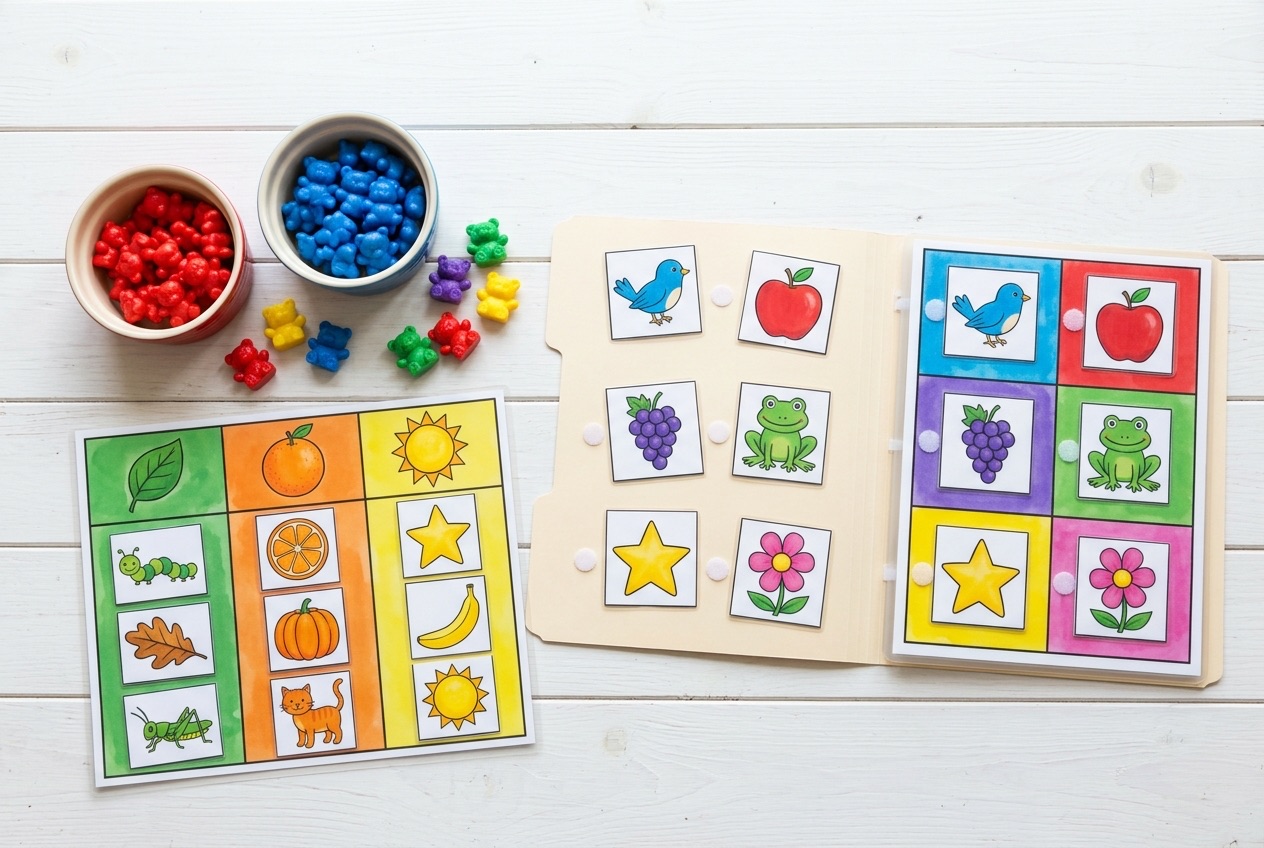
- File folder games are best for matching and sorting practice a student will do again and again independently, since the folder is self-contained, self-correcting with Velcro placement, and easy to store and reuse. See File Folder Games for Autism for how to build and store them.
- Task boxes work well when the sort involves real, three-dimensional objects, buttons, plastic animals, utensils, rather than laminated cards, since the box holds bulkier materials and the "open, sort, close" routine mirrors the file folder routine exactly. How to Set Up Task Boxes for Independent Work covers setup.
- Cookie sheets and magnetic sorting are a good fit for a teacher-led small group or a fidgety student who benefits from a bigger workspace and magnetic pieces that won't slide off the table.
Building discrimination difficulty on purpose
Matching only builds a skill if the difficulty is calibrated to the student. A field of one obvious choice teaches almost nothing once a student has mastered basic matching, while too many similar distractors too early causes frustration and guessing. Visual Discrimination Activities for Special Education walks through how to adjust field size and distractor similarity as a student progresses, which is the same skill that underlies good matching and sorting design.
Where to find ready-made matching and sorting materials
Just File Folder Games has matching and sorting activities across every level of the progression above, including plenty of preschool file folder games built around identical and non-identical matching for your youngest learners. For bigger, hands-on sorting jobs, Big Sorting Activities gives you oversized, tray-based sorting tasks, and printable autism tasks round out a rotation with more independent-work options.
Signs a student is ready to move up a level
It's tempting to move a student to a harder matching or sorting task as soon as they get a few trials right, but a real skill needs to hold up under a bit of variety first. Look for accuracy across multiple sessions, not just one good afternoon, and check that the skill transfers to slightly different materials, a student who can match identical apple pictures but falls apart when the apples are photographed from a different angle hasn't fully mastered identical matching yet. Once a student is consistently accurate across a few sessions and a few material sets, that's the signal to introduce the next level of the progression.
Common mistakes in matching and sorting instruction
A few patterns show up again and again in classrooms and are worth watching for:
- Jumping straight to sorting by category. Category sorting is the most abstract skill on the ladder. If a student is guessing rather than reasoning, drop back to identical matching or sorting by a single obvious feature.
- Using materials that are too similar too soon. If every distractor looks nearly identical to the target, even a student who understands the concept will struggle. Start with distractors that are obviously different, then narrow the difference as the student improves.
- Testing with the same exact materials used for teaching. A student can appear to have mastered a skill just from memorizing card position or a specific picture. Test generalization with a new but related set of materials before calling a skill mastered.
Building a matching and sorting rotation
Because this skill spans such a wide range, from a toddler's first color match to a functional grouping task for an older student, it's worth keeping a running bank of activities at a few different levels rather than one folder per skill. Rotate in new folders and boxes regularly so students don't simply memorize a specific game, and mix formats across a week, some file folders, a task box, a cookie sheet activity, so the underlying matching or sorting skill gets practiced in more than one context.
Where to start
If you're not sure where a student sits on the progression, start with identical matching using items you know they already recognize. If that's instant and error-free, move up a level. If it's not, that's your starting point, not sorting by category.
Looking for more? Browse all Guides & Resources, or contact us with questions.