
Life Skills and Work Tasks for Special Education: A Teacher's Guide
By Natalie · Special Education Teacher · July 19, 2026
Life skills and work tasks are activities that teach the functional, vocational, and independence skills a student needs outside of academics, things like sorting mail, counting money, following a recipe, or completing a job-like task from start to finish. For older students in special education, especially those working toward employment or greater independence after graduation, these tasks matter just as much as reading and math.
Why life skills belong in the classroom
Academic goals get most of the attention, but functional independence is what actually determines how much support a student needs as an adult. A student who can sort, follow a multi-step routine, and complete a work task without prompting is building the exact skills that translate to a job, an apartment, or a community outing. Life skills work also tends to be highly motivating for older students, since the tasks look and feel like real jobs rather than school worksheets.
What counts as a life skills or work task
- Functional academics. Reading a menu, counting change, telling time, reading a simple recipe or shopping list.
- Vocational tasks. Sorting, assembling, folding, packaging, and other repetitive jobs modeled on real workplace tasks.
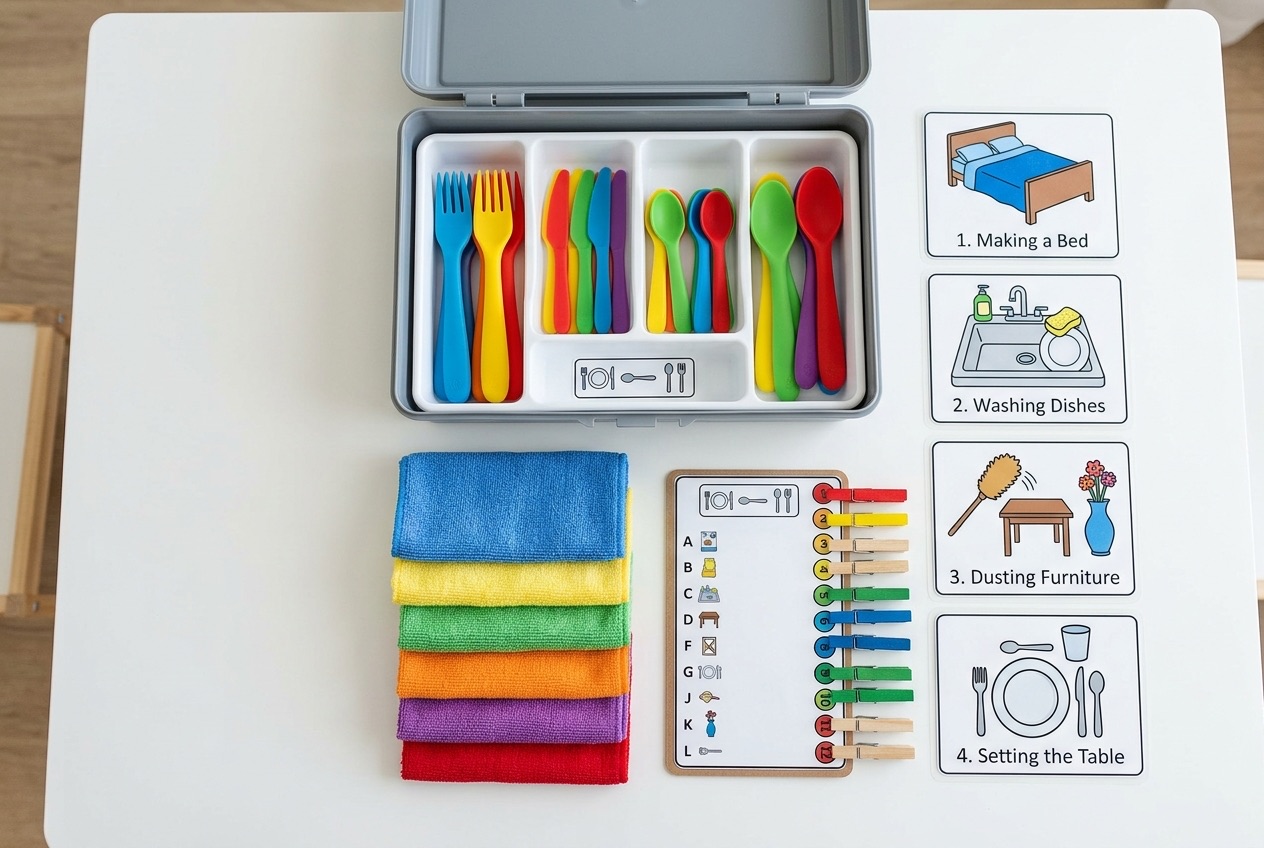
- Home and self-care. Setting a table, matching socks, following a chore checklist, packing a bag.
- Community skills. Reading signs, using a calendar, practicing safety routines for getting around outside the classroom.
Task boxes for older students
The task box format that works so well for younger learners scales up easily for teens and young adults, you just change the content, not the structure. A task box for an older student might hold nuts and bolts to sort by size, silverware to sort and bundle, or forms to fill out, instead of shapes or letters. If you haven't set up a task box system yet, How to Set Up Task Boxes for Independent Work walks through the setup step by step, and the same principles, one clear job, everything needed inside the box, a defined finish, apply whether the student is four or eighteen.
Building independence, not just completing tasks
The goal of life skills work isn't just getting through the task, it's the student doing it without you standing over them. That's where a structured independent work system matters most for older students: a visual schedule or work system tells them what to do and in what order, and they carry it out on their own. For a student headed toward a job or a supported work placement, that independence is the actual skill being taught, more than any single task.
Building a life skills station
Set aside a shelf or bin system just for life skills and vocational tasks, separate from academic work boxes, so students learn to associate that station with functional, hands-on jobs. Rotate in real materials where you can, actual silverware, actual mail, actual coins, since generalizing from real objects to real life is much easier than generalizing from a laminated worksheet.
Where to find ready-made life skills materials
Printable life skills resources give you ready-to-prep functional tasks across money, time, safety, and daily living skills, and task cards are an easy way to add rotating, low-prep practice to a work station. For students who are ready for hands-on vocational-style sorting and assembly, jar jobs are some of the most popular independent work tasks in a life skills classroom, since they combine fine motor practice with a real sorting job.
Deciding what to teach first
Not every life skill matters equally for every student, so it helps to start from the student's actual life, not a generic checklist. Ask what the student will need in the next year or two: will they be handling their own money soon, are they moving toward a job placement, do they need to manage a locker or a schedule with less support next year. Prioritize skills that get used often and in more than one setting, since a skill the student only practices at school rarely generalizes to home or the community on its own.
Tracking progress on life skills goals
Life skills goals are often written into a student's IEP, so it helps to track them the same way you'd track an academic goal: define what "independent" looks like for that specific task (no prompts, one verbal prompt, within a time limit), and take quick data every time the student runs the task. Because work tasks repeat so often in a rotation, this kind of data collection is usually painless, a checkmark or a prompt-level note takes seconds and gives you a real trend line over weeks instead of a guess at report card time.
Involving families and the community
Life skills that only exist at school don't do the student much good. Send home a simple list of what a student is working on so families can reinforce the same skill at home, whether that's folding laundry, counting change, or following a chore chart. Where you can, connect classroom work tasks to real community experiences, a store trip after practicing money skills, a mock job interview after practicing following multi-step directions, so the classroom practice has somewhere real to go.
Where to start
Pick two or three life skills areas that matter most for your students right now, money, time, or a specific community skill, and build a small rotation of task boxes around them. You can always add more once the routine is solid.
Looking for more? Browse all Guides & Resources, or contact us with questions.