
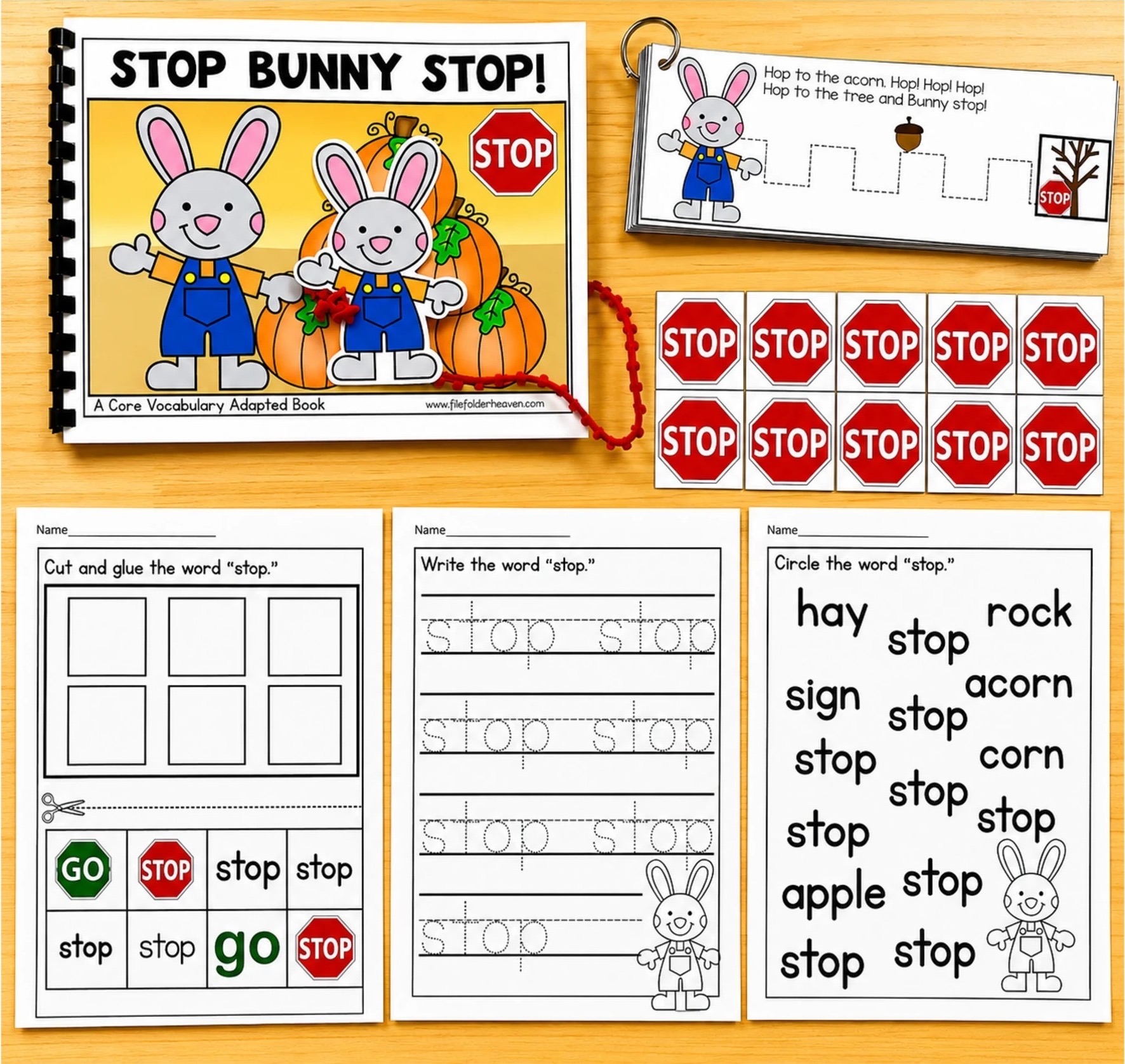
Adapted Books for AAC & Core Vocabulary
By Natalie · Special Education Teacher · July 12, 2026
Adapted books are one of the most natural ways to build language for students who use AAC (Augmentative and Alternative Communication) or who are just beginning to learn core vocabulary. Because every page invites the student to respond — to point, match, or place a symbol — an adapted book turns reading into a two-way conversation, which is exactly what AAC learners need to practice.
Why adapted books and AAC work so well together
Core vocabulary — high-frequency words like go, more, stop, want, in, on — makes up the majority of what any of us say all day. Adapted books built around core words give AAC users repeated, meaningful practice with those exact words in context. The predictable, repetitive sentence frames ("I see ___," "I want ___," "Put ___ in") model language the student can then produce on their own device or board.
They're also motivating and low-pressure. There's no wrong answer to worry about — the student participates by placing a picture symbol, and the language happens naturally alongside it.
What to look for in an AAC-friendly adapted book
- Core-word sentence frames — repetitive text built around a target word.
- Real photos or clear symbols — visuals that match the vocabulary the student sees on their device.
- One clear response per page — match, point, or place, so the student always knows how to participate.
- A single target concept — one preposition, one WH-question type, or one core word per book, so practice is focused.
How to use them
Model first, then invite. Read the book aloud while modeling the target word on the student's AAC device or a core board, then pause and give the student a chance to respond with their own symbol. Use them in small groups, one-on-one language sessions, or independent work once the routine is familiar. Speech-language pathologists love them for exactly this reason — they're structured, repetitive, and motivating.
Where to start
Pick a book that targets one skill your students are working on — a WH-question, a preposition, or a single core word — and read it the same way several times so the language becomes predictable. You'll find a large collection of ready-to-print adapted books here, including preposition and sight-word sets, and if you'd like unlimited access to a whole library, my membership site adaptedbooks.com is built just for them. New to adapted books? Start with What Are Adapted Books?
Looking for more? Browse all Guides & Resources, or contact us with questions.